Wednesday, January 21, 2009

The 44th President of The United States of America: Barack Obama


Just yesterday, Barack Obama was sworn in as the 44th President of The United States of America. This was a historic moment because Barack Obama is the first African-American president. Luckily, I was able to watch the Inauguration at school and see President Obama get sworn in. As I was researching the topic, I came upon two articles that explained the Inauguration in a great way.

The first article I read was written by the New York Times. It talked about the millions of people who joined the President and his family from the capitol to the National Mall and beyond. His many supporters started chants saying, "Obama! Obama! Obama!" The article also discussed how Barack and Michelle Obama had to attend 10 Inaugural Balls that evening. It was already a long day and President Obama had to continue it to the wee hours in the morning. I believe that Barack Obama is a great man. He is respectful, intelligent, and funny, some of the many things we need in a president. When interviewed at one of the Inaugural Balls he was quoted for saying, “Hit it, band!” That shows that he has a sense of humor. You can find the article at http://www.nytimes.com/2009/01/21/us/politics/21obama.html?_r=1&ref=us.

The second article I read was about the many people who traveled hundreds of miles to witness history. Avil Lawrence and Lou Johnson went with their children to witness the amazing moment. Lou Johnson's son is 40 and said "'To be honest Dad I never thought I'd see it.' So, here we are able to see it together." Avil Lawrence was apart of one of the first segregated classes in 1971 and was proud to witness Barack Obama become president. The article makes me understand how others feel about this moment in history. I think that it is a big step for all Americans to start new, especially at this time. The people who were apart of the celebration might not have been able to see the actual swearing in, but they were happy to be apart of the event. You can find this article at http://www.nola.com/inauguration/index.ssf/2009/01/streaming_north_witnesses_to_h.html.

Overall, I thought the Inauguration was a historical moment that will forever be remembered by our generation as well as the many generations after us. I am happy to say that I was watching and able to be alive for this amazing time.

(I got the picture of Barack Obama from: http://www.sciencedebate2008.com/www/assets/images/barack-obama-1.jpg

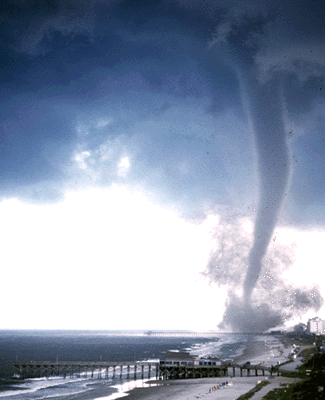
A Twisterssssss's Spin


Recently, two meteorologists at the University of Oklahoma, Nathan Snook and Ming Xue, have ran a series of simulations to study how tornadoes get their spin. First of all, tornadoes are caused by hot, humid weather in a cold clouded area. The men tested many different types of precipitation to see what could help cause a tornado's spin. Including, small hailstones, large hailstones, small raindrops, large raindrops, small hailstones and raindrops, and large hailstones and raindrops. They concluded that the size of the precipitation is a part that makes the tornado spin. When there is a small droplet of water, it is easier to evaporate, causing the rain or hail to fall to the Earth. This is also because smaller amounts of precipitation cool the air, eliminating the hot, humid air that causes a tornado. Larger droplets resist evaporation and do not cool the air during the storm, creating low pressure and starting the sucking force in the air. This force spins the air and creates the spin of a tornado. I think this is a cool topic to learn about and study because you can always witness weather and its everywhere around you. It is also cool because I never knew that something actually caused the tornado to spin, I thought it was only because that was what a tornado was. This is just another step to finding ways to prevent the damage tornadoes around the world have put onto lives and many peoples homes.

I got my information from: http://sciencenow.sciencemag.org/cgi/content/full/2009/105/2
and the picture from: http://www.billspringer.com/share/tornado/mb-tornado-01.gif

Thursday, January 8, 2009

Transverse and Longitudinal Waves


(a) is an example of a longitudinal wave and (b) is an example of a transverse wave.

This month during Science class we have been learning about transverse and longitudinal Waves. Transverse waves are waves that moves the medium at right angles to the direction in which the waves travel. Longitudinal waves are waves that moves the medium parallel to the direction in which the waves travel. Both of these waves have similar characteristics. They both have a crest, which is the high part of a wave, and a trough, which is the low part of a wave. The wave is measured by its amplitude, frequency, wavelength, and speed. In class we did many activities that correspond with waves. Such as using a slinky. When you push the slinky on one side, you can see the wave traveling through to the other side. When we were diagramming transverse waves we used a spring rope. With a partner holding the other side, we moved our hand up and down. Starting slowly, we noticed that it looked like a wave in the ocean. As we speed up, the waves became smaller and they would pass a point more frequently. I learned a lot about waves in the past weeks but when I searched transverse and longitudinal waves, I learned something new. I learned that water waves travel in a clockwise cycle. I also learned about a Rayleigh surface wave. These water waves move in a counter-clockwise cycle but deeper in the wave, it turns into a clockwise motion.

http://www.kettering.edu/~drussell/Demos/waves/wavemotion.html
http://sol.sci.uop.edu/~jfalward/physics17/chapter10/slinky.jpg(picture)

Tuesday, November 18, 2008

Robots Helping the Disabled


For the past three years, Professor Charles Kemp and Johnathan Glass have been working together on a robot that could potentially help the disabled fetch the necessities they need at home. The robot, called El-E, is 5 feet tall and moves around on wheels. With one robotic arm, it can pick up anything from a water bottle to handing the elderly their vitamins. The El-E is not yet able to pick up cell phones or other small devices but Kemp and his colleagues are still working hard to make this robot the best it can possibly be. Along with the robotic arm, the incredible robot has other human-like features such as, two eyes. I believe this is a great use of technology. I think that these robots can help many people around the world. For some people it may seem like an easy thing to reach out for the television clicker but for some it is extremely difficult. I think the robot will make many peoples life easier. Finally, I believe this is more of what we need in this world. People using their smarts to create robots or aids for people who really need it.

I got my information from:
http://www.cnn.com/2008/TECH/science/12/01/robot.health.aide/index.html

Symbiosis: A Relationship Between A Vine and Tree


Above, the vine wrapped around the tree is a relationship known as parasitism. Parasitism is a relationship where one living thing benefits while the other is harmed. While this picture might look like an innocent tree with leaves gently laid around it, the vine is actually choking the tree. There are many reasons to explain this unique relationship. First, the vine grows in the canopy of a tree and blocks the process of photosynthesis by covering and killing the trees leaves. When the vines become too heavy they also cause the tree to topple and die. Secondly, competition comes into play. The vines compete with the tree's roots for necessary elements, such as nitrogen. This is important to nature because vine seeds, such as ivy, can spread to other forests where it can strangle native vegetation and injure other trees. Often what needs to happen in order for the trees to live in vine covered areas is for a few trees and vines to be cut back. If this does not happen, entire forests could be blighted.

This website helped me get my information:
http://www.treesatlanta.org/vines.html
The picture I originally found was deleted so I got this tree from:
http://www.larryhester.com/tree-vines-s.jpg

Tuesday, October 21, 2008

Hydrothermal Vents/ Alvin

Hydrothermal vents are cracks in the ocean floor that send out jets of hot water. Instead of sunlight many underwater creatures get their energy from these vents. Along with the water minerals and bacteria are carried into the ocean water. The sizes can range from one inch to six feet. Several dozen vents have been discovered. My student teacher is apart of a program called an Alvin. An Alvin is a three person submarine that goes under water and searches for hydrothermal vents and experiments to find out more about them. During the French's Project FAMOUS in 1997 they noticed the first sighting of vents and unknown creatures using Alvin. Since 1977, other hot springs and creatures have been found at many sites along the East Pacific Rise.

I got my information from: http://pubs.usgs.gov/gip/dynamic/exploring.html

Friday, October 17, 2008

Smart Students, even SMARTer Technology.

Earlier this week my science class recieved a SMART Board. You use a projector to project onto the SMART Board your computer. This includes, the internet, Word documents and coloring pages. The board is touch screen. Using special pens you can write on any document you choose. So far we have used the SMART Board to watch vidoes on ecology and label organizers using the pens. The SMART Board was created in 1991 and was the first interactive whiteboard. Ever since, it has been the leading interactive whiteboard, "Combining the simplicity of a whiteboard with the power of a computer." Two new things i learned about the SMART Board is that it was the first interactive whiteboard, and that the SMART Board is used by astronauts. I think the SMART Borad is one of the best inventions in modern day. With this board students around the world can have a fun, easy way to learn. I believe the SMART Board will be a great success for years to come. My students and I are very fortunate to be able to have one of these pieces of history in our classroom.

I got my information from:
http://education.smarttech.com/ste/en-US/News+and+research/Research/International/
http://www2.smarttech.com/st/en-US/Products/SMART+Boards/
and go to
http://www.smarttech.com for more.