Tuesday, May 13, 2008

Global Winds and Air Pressure


Recently in my purple science class we learned about air pressure and global winds. Air pressure is based on the temperature the water vapor and the elevation. The higher the altitude the lower the density and the lower the altitude the higher the density. "High" density is more dense and has fair weather. Also it is more dry than areas with a lower density. "Low" density has stormy weather and is less dense. Along with that the ground that has a less dense air has a moist or wetter ground.

Global winds are a very important part of our weather. The corolis effect is when the northern hemisphere winds cuve right and the southern winds curve left. Trade winds are about 30 degrees north and south of the equater. This is when the warm air rises from the equator cools and begins to sink. Horse latitudes are 30 degrees north and south. They are called the horse latitudes because they used to throw horses off of the boats because they were too heavy t carry along their trip. Prevaling westerlies are 40- 60 degrees. They are located in the latitude of both hemispheres. They are also very strong winds. Polar Easterlies are 50- 60 degrees latitude. The cold air is deflected by the corolis effect.

Air pressure is measured by a barometer. Two of the most common are the mercury barometer and the aneroid barometer. The aneroid barometer uses an aneroid cell to measure pressure. On the other hand, a mercury barometer is a tube with a reservoir of mercury at one end.

I got my information from:
http://www.uwsp.edu/geo/faculty/ritter/geog101/textbook/circulation/air_pressure_p_1.html

Tuesday, May 6, 2008

Water Currents


During class about two weeks ago, my class preformed an experiment on water currents and El Nino. Our friends from Rutgers helped us do this experiment. This experiment was preformed using a tank filled with water, food coloring, salt and three dividers. First, we put a divider into the middle of the tank. This split the water into two halves. On one side we put no salt. On the other side we filled it with about 10 table spoons of salt, making it more dense than the other side of water. To discern the two sides we put a drop of blue food coloring into one side. When the divider was released the two sides acted as currents. Slowly, the more dense side (blue water) shifted under the less dense side (clear water). Density is based on how thick the substance is. You can find density by using the formula: mass /volume. To conclude the experiment, we split the water into thirds and added more salt to only one of the sides. Our class discussed that this is how the currents move inside an ocean.

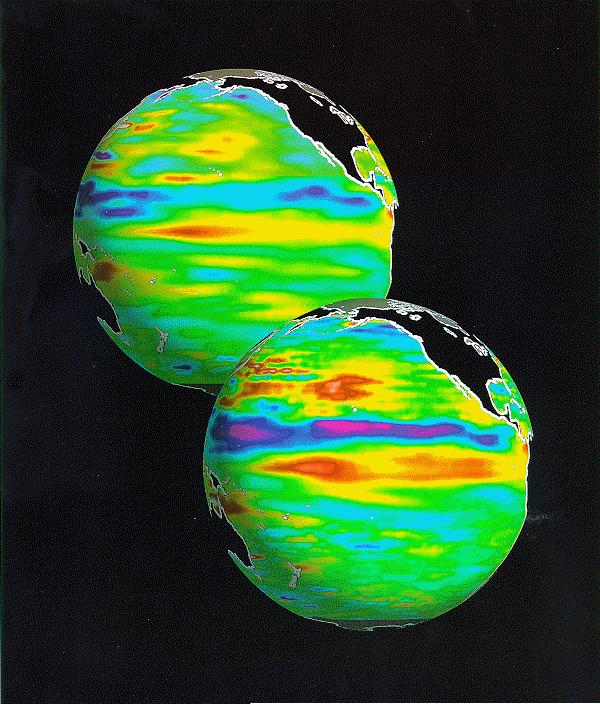
I learned that there are two different formulas for predicting tides. One formula is (2) dh/dt = - Sum{aƒH sin[at + (Vo+u) - K]} = 0. Wow! That is crazy!I also learned that the most recent El Nino was on January 3rd, 1998.The picture above of the earths levels of warm water between normal and mild El Nino of 1995 and 1996. The highest water level is illustrated with red.

i got my information from
[http://antwrp.gsfc.nasa.gov/apod/ap980113.html]
[http://co-ops.nos.noaa.gov/predmach.html]

Tuesday, April 22, 2008

Social Studies- Technology

When I asked my dad how technology has changed in the past thirty years, he didn't hesitate. He said that the way computers work and how they are used changed the most. The way people communicate was effected because in 1978 americans wrote letters and used the telephone. Now you can talk to anyone in the world with a touch of a button, using e-mail. As well as that, the way people find information was effected by the invention of the computer. To find information thirty years ago you would need to go to the local library and pick up and encyclopedia, using the computer you can find out any and everything. To emphasize, my dad said that when computers first came out, only the people who could afford them had them. His school didn't even have them! Now, most schools have computer labs filled with IBMS, and MACS. Overall, technology has drastically changed in the past thirty years.

Sunday, March 9, 2008

Math Extra Credit 2: National Pi Day!


On March 14, geeks of the world unite for national Pi Day. March 14 being, 3.14 are the first three digits of Pi. At approximately 1:59 pm- 3.14159 being the first 6 digits of pi, the annual ritual Drop of the Giant Pi takes place at pi ground zero. What is the history of pi? Pi is an extremely old number. It goes back to the time of the Babylonians and Egyptians. Although they didn't have as good of an understanding as we do today, they had figured out that it was a little bigger number than three. I believe National Pi Day is just a day to show the significance of Pi to the world. Also, I believe there is no reason to have national Pi Day because to most of the students and citizens around America, Pi is just an ordinary number.

Math Extra Credit 1

Researchers at the University of Chicago experimented on approximately 176 students in third and fourth grade. The researchers randomly assigned the children different gestures, no gestures, and not told anything. They were looking to find how the students solved the 6 math problems given. On a videotape, they recorded how the students explained the problem using their gestures. Children who were told to move their hands when explaining how they solved the problems were 4x as likely to solve the problems correctly. The findings concluded that body movement not only helps students and people to think better. Gesturing may be more accessible, and break through the roadblock. A report on these findings appears in the November issue of JEP: General, which is published by the American Psychological Association (APA).
[http://www.sciencedaily.com/releases/2007/11/071104191551.htm]

Monday, February 25, 2008

Popping Fun

Recently, my science class preformed a lab experiment using vinegar, baking soda, a test tube and a cork. During this lab we had to create a chemical reaction by adding baking soda to a test tube full of vinegar. Our goal was to hit the window at the other side of the room. For our first try, we used 20 mL of vinegar and 20 mL of baking soda. That try, we hit the window. Every other try after that, we used the same amount of baking soda as vinegar. Three out of seven trys we hit the window. I learned that if you measured the right amount of vinegar and used all of the baking soda, the cork will hit the window, easily. Also, the sucess of hitting the window would depend on the angle of the test tube when the cork is released. If the test tube was angled too low, the cork would hit the celing causing the cork to drop to the floor. If the release point was too low, the cork would shoot straight to the ground. Over all, this experiment was a fun, enjoyable experience, but I also learned many interesting lessons about chemical reactions.

Tuesday, January 15, 2008

Biofuled Bus

Three men are on a road trip attempting to make it across the country using a bus fueled by biodiesel. Chris, Micah and Nobu are searching backyard innovations and earth friendly inventions to keep the bus running starting in Las Angeles. This new television show includes many ecofriendly inventions such as biodegradable plastic, a skateboard with soy, hemp and bamboo, and home insulation with mushrooms. They are doing this because they are searching for ways to stop global warming and create a batter envierment for everyone. In my opinion this is a great way to help the world realize what is happening to our envierment and how to change it for the better. Also, I think these new findings will soon be used all throughout the country and world so global warming is a thing of the past.
[http://science.discovery.com/fansites/invention-nation/invention-nation.html]